

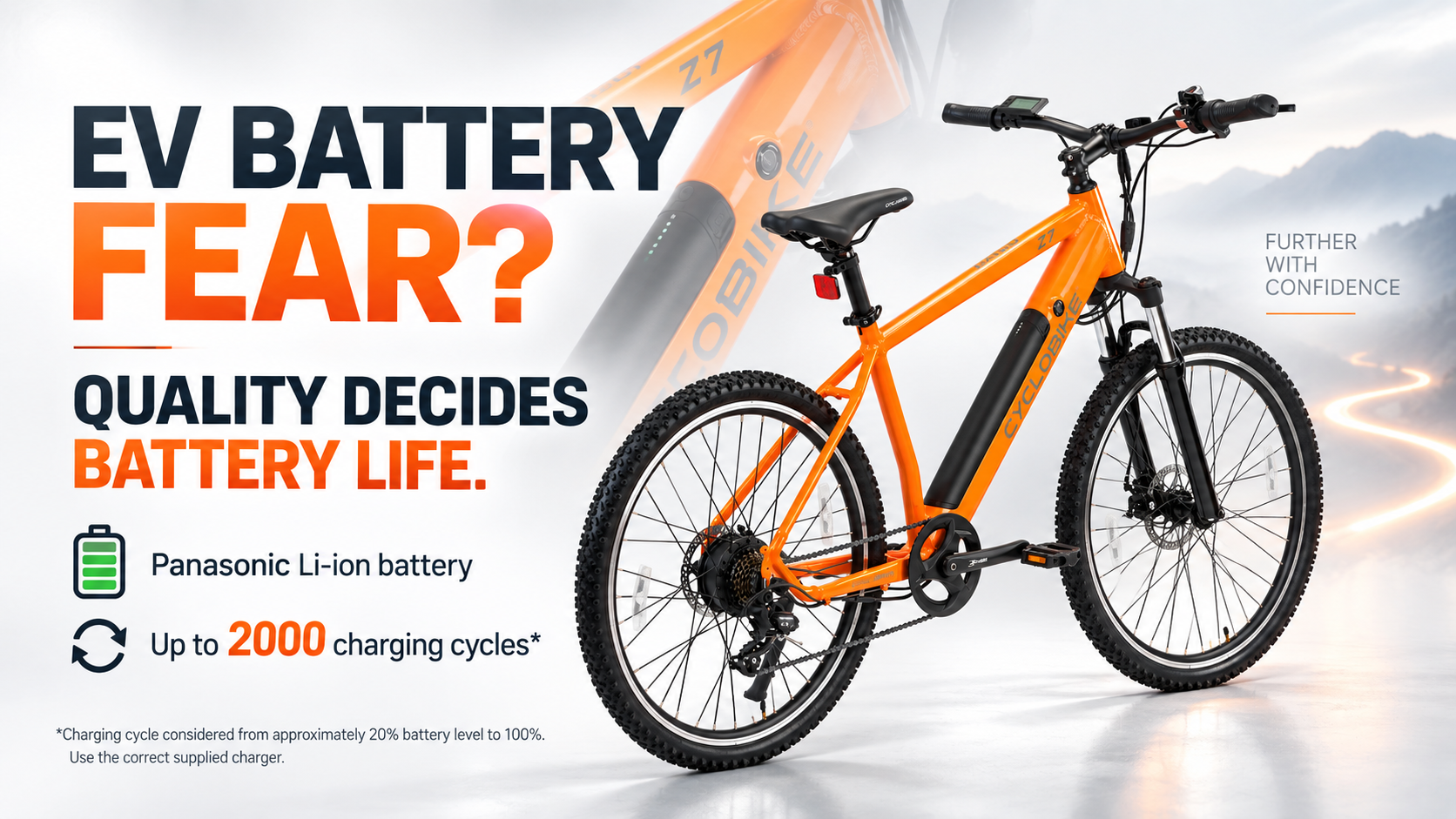
EV BATTERY FEAR: WHAT REALLY DECIDES BATTERY LIFE?

A Cheap EV Can Become Expensive When the Battery Gives Up Early.
The cheapest e-bike may not always be the least expensive e-bike to own.
Electric vehicles are becoming a part of everyday mobility. Yet before buying an electric car, scooter or electric bicycle, one concern continues to come up repeatedly:
“What will happen to the battery after a few years?”
It is a valid question.
The battery is one of the most important, and expensive components of any electric vehicle. Modern EVs have become more capable because battery technology has advanced enormously, but better battery technology also adds to the cost of the vehicle.
This is where buyers need to understand one very important fact:
NOT ALL LI-ION BATTERIES ARE THE SAME.
Two electric bicycles may both advertise a “Lithium-ion Battery.”
Their capacities may even look similar on paper.
But the quality of the cells, battery management, charging system, construction and expected battery life can be very different.
And those differences may determine whether the e-bike remains dependable for years—or becomes expensive to own much earlier than expected.
Battery Life Should Be Understood Through Charging Cycles
Many buyers ask:
“How many years will this battery last?”
Years alone do not give the complete picture.
A much more meaningful parameter is the battery’s charging-cycle life.
In simple terms, charging-cycle life indicates how many times the battery is designed to be charged during its useful operating life under the specified charging conditions.
CYCLOBIKE uses Panasonic Li-ion batteries designed to sustain up to 2,000 charging cycles*.
UP TO 2,000 CHARGING CYCLES*
*For the stated cycle-life reference, charging is considered from approximately 20% battery level to 100%.
This is important because the customer should not look only at:
“How far will my e-bike travel on one charge?”
Another equally important question is:
“How many times can I charge this battery during its useful life?”
This is where battery quality begins to influence the real lifetime cost of an electric bicycle.
A cheaper battery may help reduce the purchase price of an e-bike today.
But if that battery reaches the end of its useful life substantially earlier, replacing it can change the economics completely.
The Wrong Question: “How Fast Does It Charge?”
Another question we frequently hear is:
“How much time does the battery take to charge?”
Charging time matters.
But faster charging does not automatically mean better charging.
Every EV battery is designed to operate within specified voltage and charging-current limits.
That is precisely why, when you buy an electric vehicle, the manufacturer or supplier provides a charger designed to work with that particular battery system.
The charger is not just an accessory.
It is part of the battery system.
If a battery has been designed for a particular charging current, simply using a higher-rated or incompatible charger in an attempt to charge it faster is not necessarily beneficial.
Higher charging current can create additional heat and stress on Li-ion cells unless the battery, charger and Battery Management System are specifically engineered to support it.
Over time, incorrect charging can adversely affect battery performance and useful life.
So instead of asking only:
“How quickly can I charge my EV?”
perhaps the better question is:
“AM I CHARGING MY BATTERY THE WAY IT WAS DESIGNED TO BE CHARGED?”
At CYCLOBIKE, the appropriate charger is supplied to match the battery system.
The simple rule for the owner is:
Use the supplied or specifically approved charger.
Do not change to a higher-rated charger merely because it promises to save some charging time.
Saving an hour today should not come at the cost of shortening battery life tomorrow.
Why CYCLOBIKE Uses Panasonic Li-ion Batteries
Price competition in the electric bicycle market is intense.
Naturally, customers want an affordable e-bike.
Manufacturers also try to make their products more economical.
But every reduction in manufacturing cost has to come from somewhere.
The battery is one of the costliest components of an electric bicycle. Therefore, the type and quality of cells used inside the battery can have a major influence on the final selling price.
This is one area where CYCLOBIKE has consciously chosen quality over the lowest possible cost.
CYCLOBIKE uses Panasonic Li-ion batteries because the battery is not something we consider merely necessary to run the motor.
It determines:
Reliability.
Range.
Charging-cycle life.
Customer confidence.
And long-term ownership cost.
In many economical branded and non-branded e-bikes, the battery can become one of the weakest links if lower-cost battery cells are used simply to achieve an attractive selling price.
CYCLOBIKE takes the opposite approach.
We would rather explain why a good battery costs more than make the customer discover later what an inadequate battery can cost.
Purchase Price and Ownership Cost Are Not the Same
Imagine two electric bicycles.
The first costs less to purchase.
The second costs somewhat more because it uses higher-quality components.
At first glance, the first bicycle appears to be the better bargain.
But now look several years ahead.
If the lower-priced e-bike requires an expensive battery replacement much earlier, while the better-quality battery continues to perform, which bicycle was actually cheaper?
This is why a customer should distinguish between:
PRICE OF PURCHASE
and
COST OF OWNERSHIP
They are not always the same.
A product that saves money on the day of purchase can sometimes cost considerably more during its lifetime.
And nowhere is this more important in an EV than in its battery.
Range Is Not Decided by the Battery Alone
Another common mistake is to compare electric bicycles purely by battery capacity.
Two batteries may have similar electrical specifications, yet the two e-bikes may still give different practical ranges.
Why?
Because energy can also be lost through the bicycle itself.
The motor has to overcome:
- rider weight,
- vehicle weight,
- road gradient,
- tyre pressure,
- speed,
- wind,
- mechanical resistance, and
- friction within the moving components.
Every unnecessary resistance requires additional energy from the motor.
And every additional demand on the motor ultimately comes from the battery.
This is why good engineering is not about one impressive component.
It is about making the complete bicycle work efficiently together.
Even the Wheel Hubs Matter
CYCLOBIKE uses sealed-bearing hubs as part of its approach to efficient construction.
To many buyers, a wheel bearing may seem like a very small component.
But efficiency is often created by small details.
A wheel that rotates smoothly with lower mechanical resistance requires less effort to keep moving.
That means the motor does not need to waste battery energy overcoming unnecessary friction.
Over a journey, such efficiencies contribute to better utilisation of the available battery energy and help CYCLOBIKE deliver strong range-per-charge performance.
That is why range should never be judged by battery capacity alone.
Battery quality matters.
Motor efficiency matters.
Controller efficiency matters.
Mechanical efficiency matters.
Bearings matter.
The complete system matters.
Don’t Buy an E-Bike by Comparing Numbers Alone
Customers understandably compare specifications.
Voltage.
Amp-hours.
Watt-hours.
Motor wattage.
Range.
Charging time.
All these numbers have value.
But they do not tell the complete story.
Before choosing an electric bicycle, also ask:
Who makes the battery cells?
What is the expected charging-cycle life?
What charger is supplied with the battery?
Is the battery-management system properly matched?
What quality of bearings and mechanical components are used?
How efficiently does the complete e-bike utilise battery energy?
Who will support the bicycle after the sale?
These questions may tell you considerably more about the real value of the e-bike than simply comparing its showroom price.
Should Battery Fear Stop You From Buying an EV?
No.
Battery fear should make you a better-informed EV buyer, not prevent you from adopting electric mobility.
An electric bicycle can offer an exceptional combination for everyday transportation:
Low running cost.
No petrol consumption while riding.
Easy parking.
Low-speed personal mobility.
Physical activity through pedalling.
Electric assistance whenever required.
And a practical alternative to taking a petrol two-wheeler or car for every short journey.
But these benefits become far more valuable when the e-bike continues to perform reliably year after year.
That is why quality matters.
The Real Question Is Not: “Why Is This E-Bike Costlier?”
Perhaps the better question is:
“WHAT AM I GETTING FOR THE EXTRA COST?”
A better battery?
Longer expected charging-cycle life?
Better bearings?
Higher-quality electrical components?
Better efficiency?
More dependable after-sales support?
Longer useful ownership?
If the answer is yes, then a higher initial price may not necessarily mean a more expensive product.
It may actually mean a lower long-term cost of ownership.
ONE PRINCIPLE EVERY EV BUYER SHOULD REMEMBER
When buying an electric vehicle, it is tempting to focus on the lowest price.
But an EV is a combination of a battery, electronics, motor and mechanical components that must continue working together for years.
Compromising on an important component merely to reduce today’s purchase price can create tomorrow’s expense.
That brings us to one principle we strongly believe in at CYCLOBIKE:
QUALITY IS COSTLIER.
BUT LACK OF QUALITY CAN BE EVEN MORE COSTLY.
When you buy an electric bicycle, don’t simply buy the battery capacity written on the specification sheet.
Buy the quality behind that battery.
Don’t ask only how quickly it charges.
Ask whether it is being charged correctly.
Don’t ask only how far it goes today.
Ask how dependably the complete e-bike is designed to serve you tomorrow.
Because the true value of an electric vehicle is not decided on the day you purchase it.